Freer and Sackler Art Gallery Who Is the Founder Library of Congress
Opened in 1923, the Freer Gallery of Art was the first art museum of the Smithsonian Institution. Information technology is named for Charles Lang Freer, who donated his collection of Asian and American art to the United States government in 1906. With the adjoining Sackler Gallery, the Freer and Sackler Galleries contain the nation's premier collections and exhibits of Asian, Centre Eastern, Indian, and Islamic art, likewise as the largest research library in the United States related to these forms of fine art.
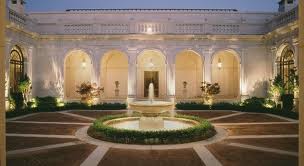
The Courtyard of the Freer Gallery of Art
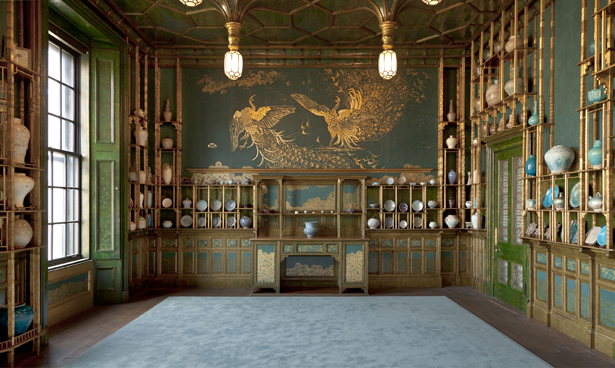
James McNeill Whistler'southward Peacock Room
In altruistic his collections, Charles Lang Freer helped plant the first art museum within the Smithsonian Institution. Courtesy of the Smithsonian Establishment Archives.

After a lucrative career in manufacturing and railroads, Charles Lang Freer (1854-1919) of Detroit devoted his retirement to collecting art and traveling. Though he began his art drove in the 1880s, he began actively collecting upon his retirement in 1900, and by 1904, approached President Theodore Roosevelt with the thought of altruistic his collection to the United States government. Freer collected more than 9,000 pieces of art and manuscripts, focusing on works from Red china, Japan, Egypt, Republic of india, and the Middle East. Freer owned ane of the largest collections of art past American creative person James McNeill Whistler, Asian-inspired works likely sparked Freer's interest in Asian art.
Freer donated his individual drove to the Smithsonian Institution in 1906, with stipulations that the gallery could non loan the art to other institutions nor receive loans from other institutions. He envisioned an institution that was highly accessible to scholars and students of art. By establishing a singled-out art gallery outside the walls of the Smithsonian Castle, the new Freer Gallery moved forward the Smithsonian's broader vision of creating more museums throughout the twentieth century.
The Italian Renaissance construction was constructed between 1916 and 1921, designed by American architect and landscape planner Charles A. Platt. The Freer Gallery added some other museum to the National Mall, joining the Castle (1855), the Arts and Industries Building (1879), and the National Museum of Natural History (1910). Its pattern also stood out from its neighboring museums, which were built in either the Romanesque fashion (with ruby-red brick) or the neoclassical style (with columnns and marble). Like the Natural History Museum, the Freer Gallery's interior incorporated rich limestone, marble, and granite.
The Freer Gallery opened on May nine, 1923. Freer died in 1919 earlier his gallery opened, simply his legacy lives on in his namesake museum. Since its opening, the Freer Gallery has collected more than 22,000 objects from Asia, the Middle East, India, and the Islamic globe. In 1979, Congress approved construction of three new structures and gardens about the Freer Gallery, which would incorporate a quadrangle behind the Smithsonian Castle. The bordering Sackler Gallery opened in 1987 as the Smithsonian's second museum dedicated to Asian fine art. Together, the Freer and Sackler Galleries are the nation'southward premier museums for Asian fine art.
I of the almost famous works at the Freer Gallery is the Peacock Room, built past architect Thomas Jeckyll and redesigned as a work of decorative art past James McNeill Whistler. The room originated from the London mansion of Frederick R. Leyland, a British aircraft magnate, and served as his dining room. Information technology also displayed Leyland's collection of Chinese porcelain and one of Whistler's original paintings. Whistler reimagined the room betwixt 1876 and 1877, painting Jeckyll'southward Asian-inspired design in blue-dark-green hues and accenting in metallic gold leaf. Though Leyland disliked the redesign, Freer was so captivated by the space that he purchased it afterward Leyland'southward death. The room was disassembled and shipped to Freer's Detroit home until it was permanently installed in the Freer Gallery.
"Freer Fine art Open up to Public May nine." Evening star. April 29, 1923. Folio seven, Image seven. Washington, D.C. Chronicling America. Library of Congress. Accessed December 2017. http://chroniclingamerica.loc.gov/lccn/sn83045462/1923-04-29/ed-i/seq-7/
Obituary (26 September 1919). "Charles Fifty. Freer, Art Collector, Dies". New York Times. http://query.nytimes.com/mem/archive-gratis/pdf?res=9F0CE4DC123AE03ABC4E51DFBF668382609EDE
Pope, John A. "The Freer Gallery of Fine art." Records of the Columbia Historical Guild, Washington DC. 69/lxx. 1969: 380–398
Smithsonian Institution Athenaeum. "Freer Gallery of Art." Smithsonian Establishment Archives. Accessed December 2017. https://siarchives.si.edu/history/freer-gallery-art
Smithsonian Institution. "About Us." Freer | Sackler. Accessed Dec 2017. https://world wide web.freersackler.si.edu/about/
Smithsonian Institution. "Charles Lang Freer." Freer Gallery of Art. Accessed December 2017. https://www.freersackler.si.edu/about/
Smithsonian Institution. "The Peacock Room Comes to America." Freer Gallery of Fine art. Accessed December 2017. https://world wide web.freersackler.si.edu/exhibition/the-peacock-room-comes-to-america/
Source: https://theclio.com/entry/3468
0 Response to "Freer and Sackler Art Gallery Who Is the Founder Library of Congress"
Post a Comment